
Back Attack! How to Optimize Rowing & Pulling With Proper Arm Angles

Developing a great back takes time. But there are certain things you can do to optimize your program and get great results. For instance, you definitely want to have a good understanding of proper arm angles.

For the purposes of this article, I will ‘attack the back’ in pieces and give a brief explanation of each arm angle and which back muscles it targets. Let’s start from the lower lat and move our way up the back as we go!
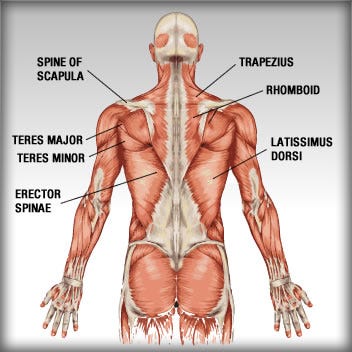
When doing lower-back rows of any kind, you want to have your elbows pointed down and tucked close to your body. Rows from this position will target your lower back, your middle and lower trapezius in your upper back, your rhomboid and latissimus dorsi in your middle back and your teres major in your outer back.
The erector spinae aren’t directly involved in this movement, but they are targeted indirectly because they help stabilize the torso. This is more true with cable or bent-over rows using free weights, and less true with machine or T-bar rows where the body is supported with a bench or pad.
While performing a mid-back row, you want to keep your shoulders depressed (down) and slightly raise your elbows higher than that of the low-back row position. Think of a 45-degree angle from your body. Rows from this position will target the middle trapezius, rhomboid and posterior deltoids (the back of your shoulders).
Next, we have a high-back rowing movement. During rows from this position, you will want to raise your elbows to the point where they are as high as you comfortably go – without shrugging your shoulders (key point).
Pro tip: One way to envision these angles is that you want to be able to draw a straight line across your back from elbow to elbow, regardless of the plane in which you are training.
Last, but definitely not least, is a lat pulldown or pull up. Working the lats from this position engages the latissimus dorsi, the largest muscle in the back, as well as your biceps, posterior deltoids, rhomboid and trapezius.
Paid subscribers: Watch me perform a lat pulldown with full range of motion.
Not a paid subscribers? Click below to fix that and support the IronQuest fitness education mission!
I recommend hitting all of the above angles over the course of a week, at least once, and increasing volume in weak areas of your back to optimize results, depending upon your time and training split. As a beneficial side-effect, you will also be training the back muscles in different planes of movement.
As my friend Brad Schoenfeld, graduate director of the Human Performance and Fitness program at Lehman College, explains:
Close grip rowing-based movements (elbows at sides) take place in the sagittal plane and thus carry out shoulder extension and scapular retraction. Wide-grip rows (elbows parallel with the ground) take place in the transverse plane. Lat pulldowns are in the frontal plane (shoulder adduction). These different planes of movement have distinct effects on targeting different areas of musculature.
Work hard, train smarter!
For Paid Subscribers Only
Click here for a typical IronQuest back routine we give our clients, which includes pictures of the exercises mentioned in the article above.